
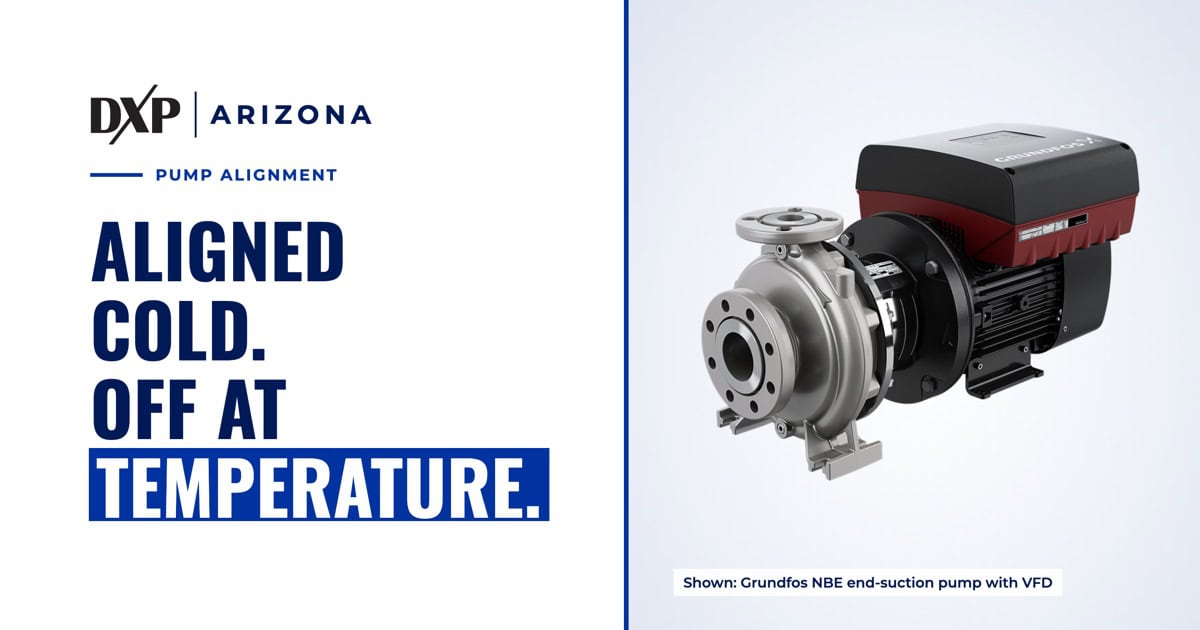
Pump alignment is one of the most important and most often underestimated factors in rotating equipment reliability. A small amount of misalignment between a pump and its driver adds vibration, raises energy use and wears out bearings, seals, couplings and shafts. Left uncorrected, it ends in failure. In many facilities, alignment problems stay hidden until repeated failures force a fix.
DXP Arizona treats proper alignment as a basic requirement for pump system performance. Precision alignment, particularly with laser alignment tools, plays a direct role in efficiency and long-term equipment health.
What Pump Misalignment Means
Misalignment occurs when the centerlines of the pump and motor shafts are not collinear during operation. It can be angular, parallel (offset) or a combination of both, and it often changes as the equipment reaches operating temperature. A pump that looks aligned at rest can drift once it runs, because of thermal growth, soft foot, pipe strain or baseplate distortion.
These conditions put uneven loads on rotating parts. Bearings carry extra radial and axial stress, mechanical seals run outside their intended operating window and couplings absorb continuous strain. Over time that stress shows up as early failures, higher maintenance costs and unplanned downtime.
The Operating Cost of Poor Alignment
Misaligned pumps rarely fail right away. They degrade steadily, which can hide the root cause of recurring problems. A facility may replace seals several times, rebuild pumps more often than expected or chase vibration alarms without identifying alignment as the cause. Vibration analysis is one way to find it.
Energy use suffers too. Misalignment increases friction and power draw, and even minor misalignment can cause measurable losses in continuous-duty service. Over the life of the equipment, those losses can exceed the cost of proper alignment. Our guide to evaluating pump energy consumption covers how to measure them.
Why Laser Pump Alignment Makes a Difference
Traditional methods using straightedges and dial indicators depend heavily on technician experience and visual judgment. They can achieve basic alignment, but they often miss the tolerances that higher-speed pump systems require.
Laser alignment systems measure shaft position in multiple planes in real time. They account for coupling geometry, soft foot and thermal growth, so technicians can align equipment to the tolerances manufacturers and industry standards recommend, with repeatable results.
Laser systems also record the alignment data. Technicians can store it and refer back to it during future maintenance, which gives condition monitoring and reliability programs a baseline.
Alignment as Part of a Reliability Program
Alignment needs checking throughout a pump’s life. Verify it after major maintenance, after a motor replacement and whenever piping or foundation work takes place. Normal wear and settling can also shift alignment over time.
DXP Arizona includes laser alignment in its field service and reliability programs, alongside vibration analysis, balancing and system diagnostics, so alignment work supports the rest of the maintenance plan.
The DXP Arizona Approach to Precision Alignment
DXP Arizona field service teams use laser alignment tools and proven procedures to align pumps for real operating conditions. Before final alignment, technicians check baseplates, mounting surfaces and piping stress so the results hold. When an alignment problem comes from a structural or system issue, the team helps find and correct that cause instead of compensating for it.
Precision alignment stabilizes operation, reduces maintenance labor, improves energy efficiency and extends equipment life. In high-demand industrial plants, those gains show up as lower costs and better uptime.
If your facility sees repeat seal or bearing failures, contact DXP Arizona at (800) 533-9710 to review your alignment practices or schedule laser alignment services.