Centrifugal pumps serve a wide range of industrial applications, but they are not always the best choice for every fluid or process. When an application involves high viscosity, precise flow requirements or challenging pressure conditions, positive displacement pumps may provide better performance.
Positive displacement pumps operate by capturing a specific volume of fluid and moving it from the inlet to the discharge. This operating principle allows them to maintain relatively consistent flow as system pressure changes. Understanding the available technologies and their strengths can help facilities select equipment better matched to their processes.
How Positive Displacement Pumps Work
Unlike centrifugal pumps, which add velocity to the fluid through a rotating impeller, positive displacement pumps move fluid by repeatedly enclosing and transferring a fixed volume.
There are two broad categories: rotary and reciprocating pumps. Rotary designs use components such as gears, screws, lobes or progressing cavities to move fluid continuously through the pump. Reciprocating designs use pistons, plungers or diaphragms to create repeated pumping cycles. The Hydraulic Institute publishes separate standards for rotary and reciprocating pumps that cover their nomenclature, application and operation.
Each technology has different operating characteristics, making some designs better suited to particular fluids or process requirements. For a broader overview of how these designs compare with centrifugal pumps, see our guide to types of industrial pumps and their uses.
Handling High-Viscosity Fluids
One of the most common reasons to consider a positive displacement pump is fluid viscosity. Centrifugal pump performance can decline significantly as viscosity increases. Thick fluids create additional friction and may reduce the flow and efficiency a centrifugal pump can provide.
Many positive displacement technologies perform effectively with viscous products because their operating principle does not depend on generating high fluid velocity.
Gear and screw pumps are frequently used for oils and lubricants. Progressing cavity pumps can handle viscous products as well as fluids containing suspended solids. Selecting the appropriate technology depends on viscosity and other characteristics of the fluid.
Consistent Flow Against Changing Pressure
Positive displacement pumps can also provide advantages when a process requires predictable flow despite variations in discharge pressure. Because a defined volume is moved during each cycle, flow is closely related to pump speed.
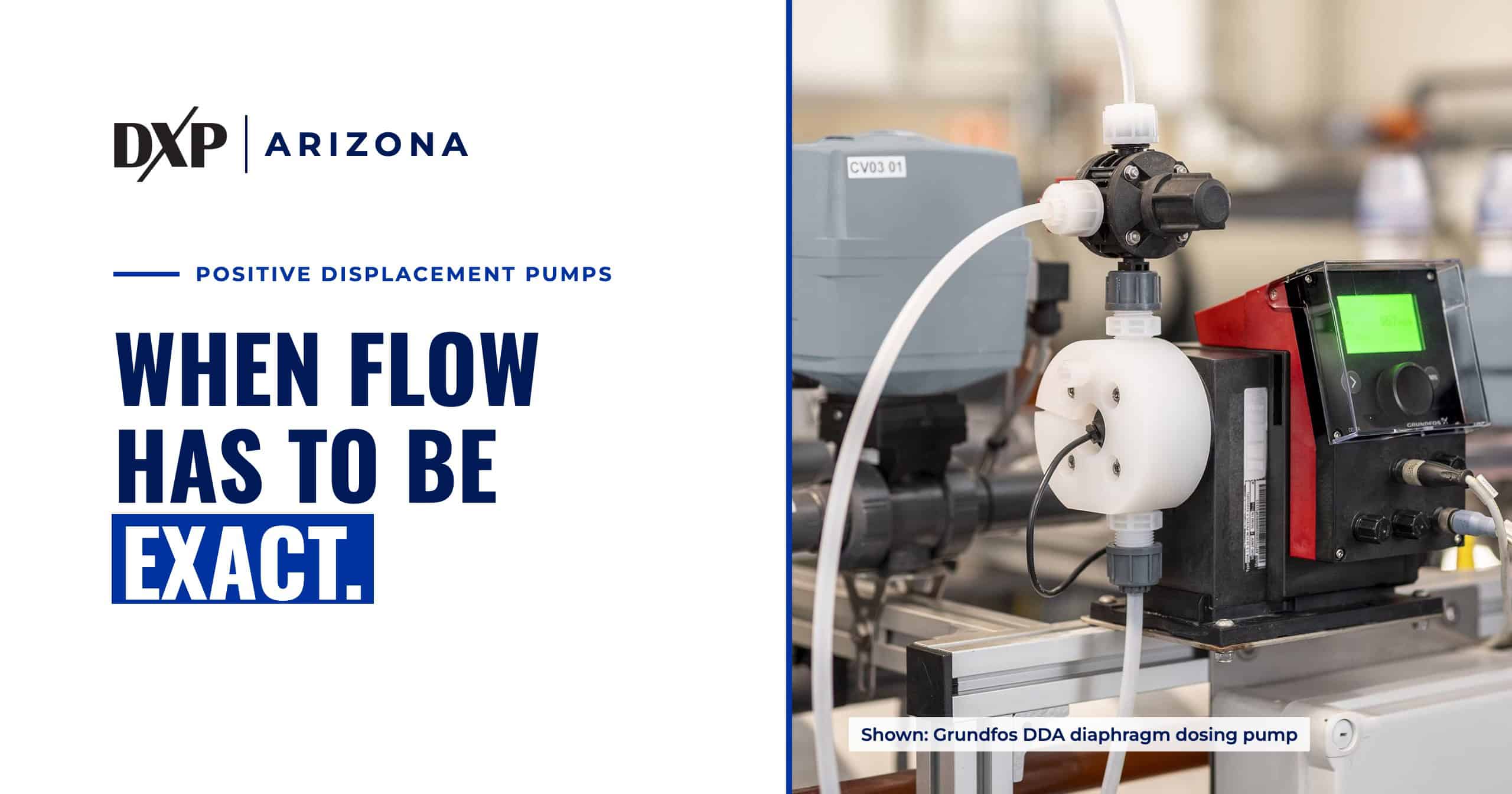
This characteristic makes positive displacement pumps useful for metering and dosing applications where controlled delivery is important. Diaphragm and other metering pump designs can deliver chemicals or additives at carefully controlled rates. Chemical service also affects which wetted materials will hold up, a topic we cover in selecting pumps for harsh chemical environments.
Their ability to develop substantial pressure also makes certain positive displacement technologies suitable for applications where high discharge pressure is required at relatively modest flow rates.
Applications Involving Solids or Sensitive Fluids
Some positive displacement designs are well suited to fluids that would present challenges for conventional centrifugal pumps. Progressing cavity pumps, diaphragm pumps and certain lobe designs can handle solids-laden fluids depending on particle characteristics and pump construction. Air-operated double-diaphragm pumps such as the SANDPIPER Beast are one example built for heavy slurry service.
Low-shear designs can also be beneficial when the product itself needs protection. Processes involving sensitive fluids may require gentle handling to avoid changing the material’s properties.
These capabilities make positive displacement technologies useful across wastewater treatment, chemical processing and other industrial environments.
Important Operating Considerations
Positive displacement pumps require appropriate system design. Because they continue moving fluid against downstream resistance, pressure can rise rapidly if the discharge becomes blocked. Pressure relief protection is therefore an important part of many installations, and it belongs in your startup and shutdown procedures as well.
Fluid properties and operating speed also require careful consideration. Abrasive solids may influence material selection, while temperature changes can alter viscosity and affect power requirements.
Matching Pump Technology to the Process
Positive displacement pumps can outperform centrifugal pumps when an application requires effective handling of viscous fluids, controlled flow or higher pressures. The key is selecting the technology around the actual process rather than assuming one pump design fits every application.
DXP Arizona works with customers to evaluate fluid characteristics and system requirements before recommending equipment, and our engineering team designs and fabricates packaged, skid-mounted pump systems around them. If your application presents challenges that a centrifugal pump cannot efficiently address, contact DXP Arizona at (800) 533-9710 to discuss positive displacement pump technologies and system solutions.