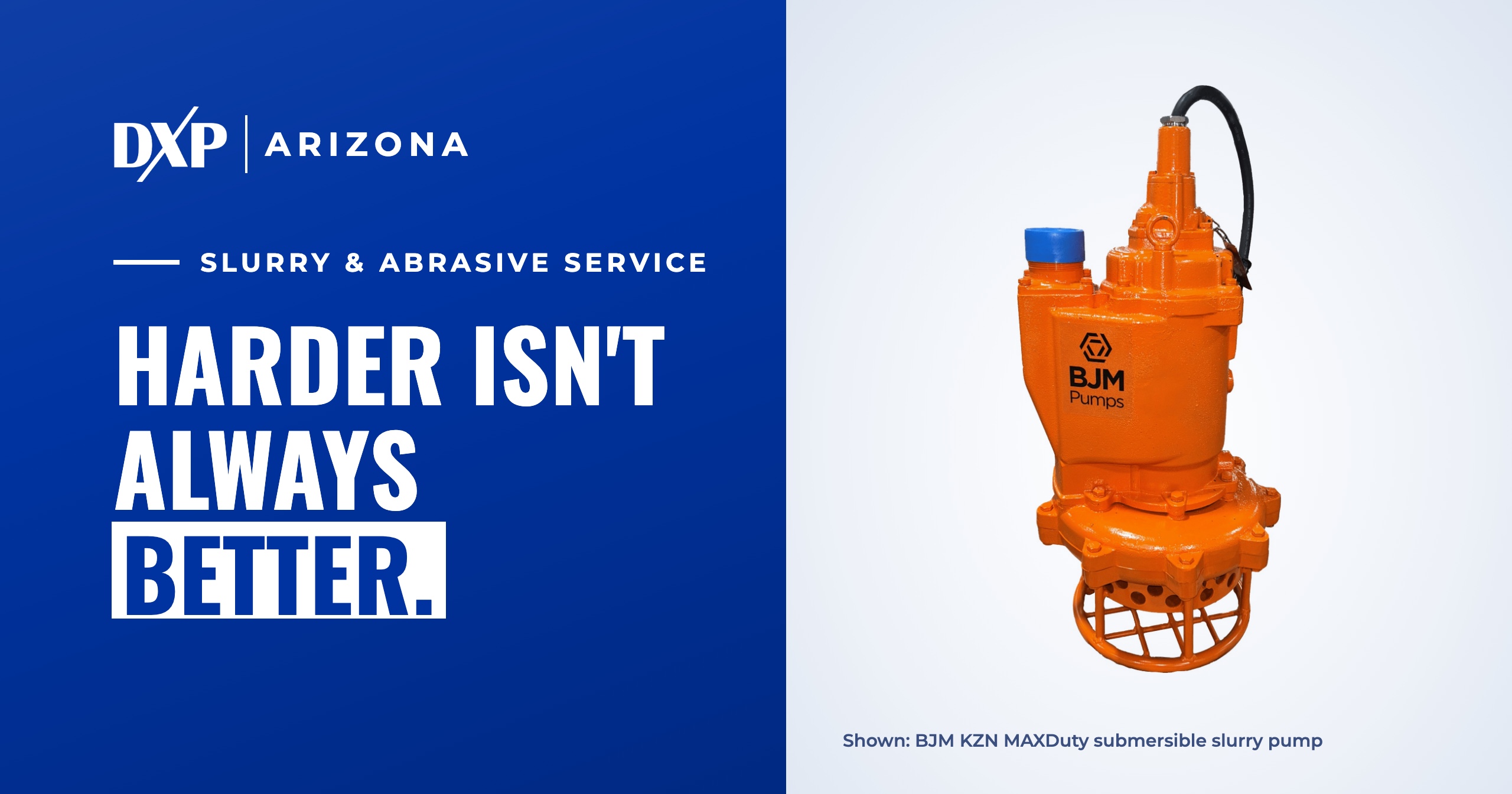
Pumping clean water presents very different challenges than moving slurry, grit or solids-laden process fluids. In abrasive applications, particles repeatedly contact internal pump surfaces at operating velocity. Over time, this can erode components, change internal clearances and reduce hydraulic performance.
Selecting materials that can withstand these conditions is an important part of pump design. However, abrasion resistance alone does not determine the best choice. Particle characteristics, fluid chemistry and operating conditions all influence how quickly a material wears.
DXP Arizona helps customers evaluate these factors to select pumps and materials suited to demanding abrasive services.
Understanding Abrasive Wear
Abrasive wear occurs as suspended particles travel through the pump and contact wetted surfaces. Sand and mineral particles can gradually remove material from impellers, casings and other internal components.
The severity of this wear depends partly on the solids themselves. Hard, angular particles may be especially aggressive, while larger solids can create different wear patterns than fine particles. Solids concentration also matters because a heavily loaded slurry exposes pump surfaces to more frequent particle contact.
Velocity is another important factor. Higher fluid velocities can increase the force of particle impacts and accelerate erosion. This is why pump selection and operating conditions need to be considered alongside material choice.
Hard Metals for Severe Abrasion
High-chrome iron and other hardened alloys are commonly used in applications where abrasion is the primary concern. Their hardness helps them resist material loss when handling mineral slurries and other aggressive solids.
These materials are often well suited to mining, aggregate processing and similar environments. Pumps designed specifically for slurry service may use hardened materials in areas that experience the greatest wear.
Hardness, however, can come with tradeoffs. A material that performs well against abrasion may not provide the corrosion resistance needed for chemically aggressive fluids. Material selection should reflect the complete fluid composition rather than focusing only on solids.
Elastomers Can Provide Effective Wear Resistance
Rubber and other elastomeric linings can also perform well in certain slurry applications. Instead of relying on extreme hardness, these materials can absorb some of the energy generated by particle impacts.
Elastomers may be particularly effective with finer particles and operating conditions suited to lined pump construction. They can also provide useful chemical resistance depending on the specific elastomer and fluid.
Temperature and particle size can limit their use. Large or sharp solids may cut or damage softer materials, while elevated temperatures can exceed the capabilities of certain elastomers.
Stainless Steels and Specialty Alloys
When abrasion occurs alongside corrosion, material selection becomes more complex. Stainless steels and specialty alloys can provide corrosion resistance that conventional hardened materials may lack.
The correct alloy depends on the chemistry of the fluid. Chlorides, acidic conditions and other contaminants can attack some metals even when those materials offer acceptable mechanical wear resistance.
In these applications, evaluating abrasion and corrosion together can help prevent solving one problem while creating another.
Look Beyond the Material
Even a highly wear-resistant pump can experience shortened life if it operates under poor conditions. Excessive velocity or operation far from the intended performance range may accelerate internal wear.
Maintenance planning should also reflect the application. Regular inspections can identify changing clearances and worn components before performance deteriorates significantly. Tracking pressure and flow over time can provide additional evidence that internal wear is affecting pump efficiency.
Selecting Materials for Long-Term Reliability
There is no single pump material that is ideal for every abrasive fluid. The best choice depends on the solids being handled, fluid chemistry and operating environment.
DXP Arizona works with customers to evaluate abrasive applications and select pump designs that balance wear resistance with overall system requirements. If slurry or solids are contributing to frequent pump wear at your facility, contact DXP Arizona at (800) 533-9710 to discuss materials and equipment designed for longer service life.